
Reranker
Rerankers re-order a candidate set of documents by relevance to a query. They sit between an initial retriever (vector search, BM25, hybrid) and the final consumer (LLM, Knowledge Engine pipeline) and dramatically improve precision at low recall depths.
Operators manage rerankers under Data → Reranker. Each reranker is project-scoped, has a unique key, and persists usage stats (totalRuns, avgLatencyMs, lastUsedAt) for monitoring.
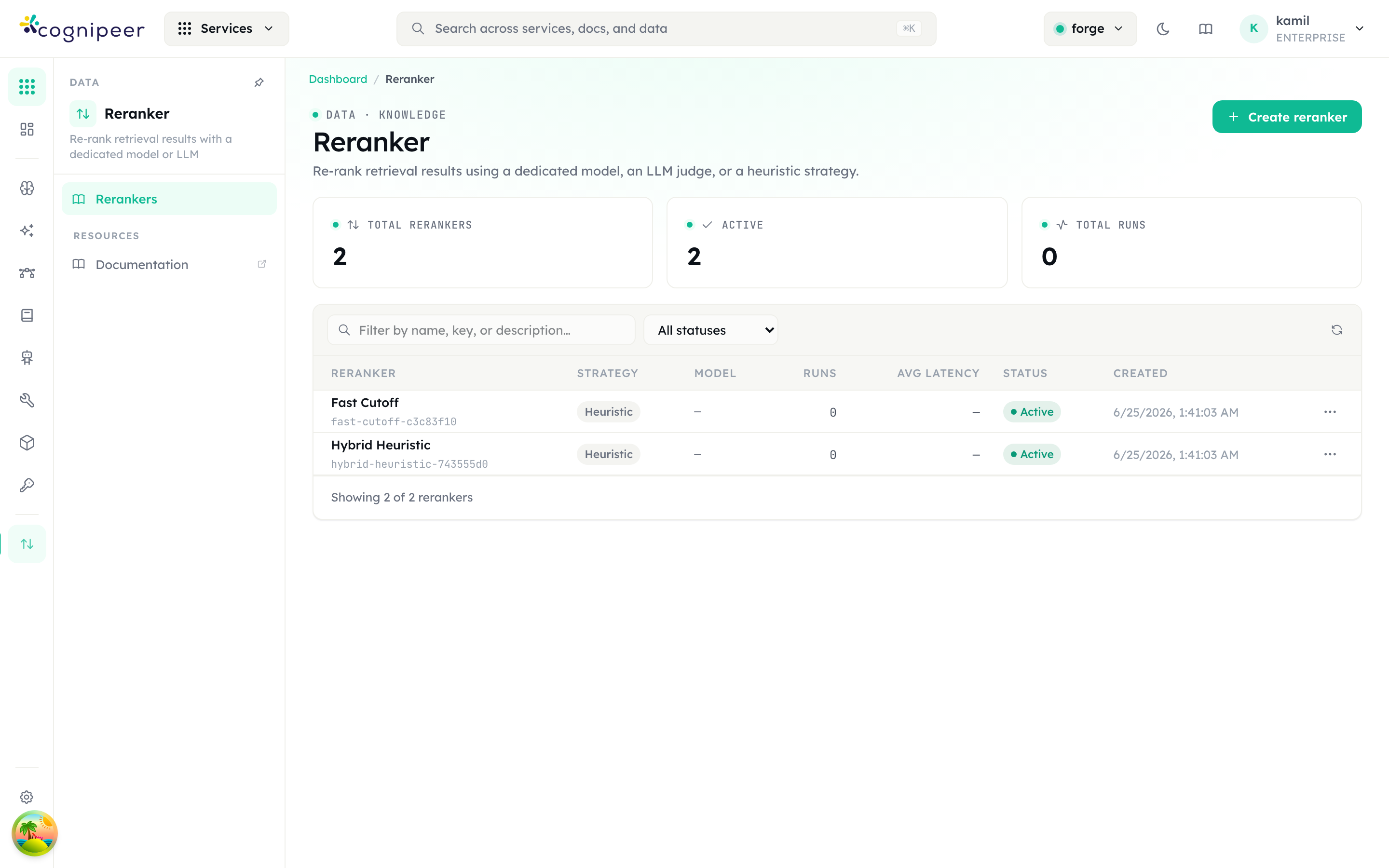
The landing page tracks total / active reranker counts and total runs, with a row per reranker showing its strategy, backing model, run count, and average latency. Create reranker opens the form where you pick a strategy (below) and bind the backing model or judge.
Strategies
The reranker abstraction supports five strategies. Pick one based on latency budget, quality target, and whether you already have a dedicated rerank model.
| Strategy | How it works | When to use |
|---|---|---|
dedicated-model | Calls a hosted cross-encoder (Cohere Rerank, Jina, Voyage, etc.) | Best quality; needs a provider integration |
llm-judge | LLM scores each (query, document) pair one-by-one | High quality without a dedicated model, costs scale with N |
llm-listwise | LLM ranks the whole list in a single call | Cheaper than llm-judge for medium N; lower latency |
heuristic | Score-aware rules (BM25 blending, length penalty, freshness boost, etc.) | Zero model dependency; tune for known corpora |
fusion | Reciprocal Rank Fusion across multiple input score lists | Combine vector + lexical scores into one ranking |
The strategy plus config payload is stored on the reranker — see src/lib/services/reranker/strategies/ for the per-strategy config shape.
Creating a reranker
curl -X POST https://console.example.com/api/reranker \
  -H "Content-Type: application/json" \
  -d '{
    "name": "support-knowledge-rerank",
    "strategy": "dedicated-model",
    "status": "active",
    "config": {
      "providerKey": "cohere",
      "model": "rerank-multilingual-v3.0",
      "topN": 10
    }
  }'
The response contains the generated key you use for subsequent calls.
Running a reranker
POST /api/reranker/:key/run accepts a query and a list of documents (strings or { id, content, score?, metadata? }) and returns them re-ordered by relevance:
curl -X POST https://console.example.com/api/reranker/support-knowledge-rerank/run \
  -d '{
    "query": "How do I reset my password?",
    "documents": [
      "Forgot password? Click here to reset.",
      "Our cookie policy explains tracking choices.",
      "Two-factor authentication setup guide."
    ],
    "topN": 3
  }'
Each run is persisted to a run-log table; GET /api/reranker/:key/runs?from=&to=&limit= returns the recent history for debugging and quality tracking.
Knowledge Engine integration
The Knowledge Engine module accepts an optional rerankerKey per module. When set, the retrieval pipeline becomes:
Query → Vector store top-K → Reranker (top-N) → LLM contextSet the reranker on a Knowledge Engine module to bolt better ranking onto an existing pipeline without changing the embedding model or vector store.
Dashboard
The reranker page lists every reranker with strategy, status, run counts, and average latency. Each detail page exposes a playground that proxies to POST /api/reranker/:key/run so you can validate the behavior with real documents before wiring it into production retrieval.
See the Reranker API reference for the full request/response schema.