
Vector Stores
The vector store service provides multi-provider vector database management with index CRUD, vector upsert/query/delete operations, and runtime pooling. Operators manage it through Data → Knowledge Index.
Knowledge Index
The list view groups indices by their vector provider. Counters at the top show how many indices are deployed, how many providers are wired up, and how many providers are currently failing health checks.
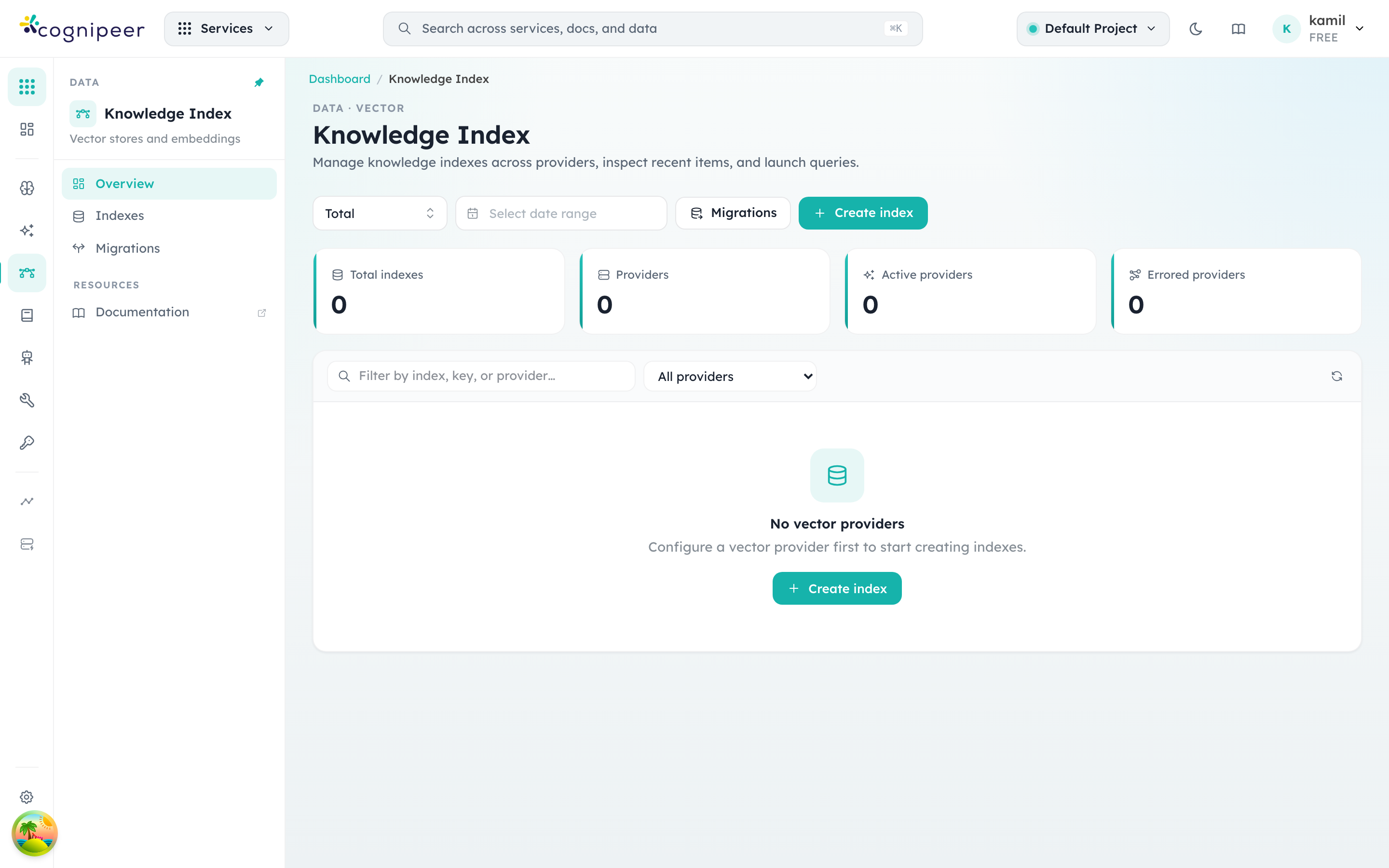
A fresh tenant lands on the empty state — the Create index action only enables once at least one vector-domain provider has been registered. The Indexes and Migrations entries in the left sidebar give you flat list views; Migrations is where you reshape indices when you change embedding dimensions or rename keys.
Supported Providers
Providers are registered through the contract system:
| Provider | ID | Description |
|---|---|---|
| SQLite Vector | sqlite-vector | Local brute-force similarity search using SQLite. No external dependencies. |
| Postgres | postgres | Postgres/pgvector-backed vector storage |
| Azure AI Search | azure-ai-search | Managed vector search on Azure AI Search |
| AWS S3 Vectors | aws-s3-vectors | S3-based vector storage |
Additional providers can be added via the provider contract mechanism.
SQLite Vector Provider
The built-in SQLite vector provider stores embeddings locally with brute-force cosine/dot/euclidean similarity search. Ideal for development, small-scale deployments, or environments without external vector database access.
# No extra configuration needed — just create a provider via API or UI
# with driver: "sqlite-vector" and settings.basePath: "./data/vectors"
Capabilities:
- Cosine, dot-product, and euclidean similarity metrics
- Upsert with conflict resolution
- Batch vector operations within transactions
- Per-tenant, per-provider isolated SQLite files
Limitations:
- Brute-force search (scans all vectors per query) — suitable for up to ~100K vectors per index
- No metadata filtering (planned)
Service Layer
The vector service (src/lib/services/vector/vectorService.ts) provides tenant-scoped operations:
| Function | Description |
|---|---|
listVectorDrivers() | List available vector provider drivers |
listVectorProviders() | List tenant's configured providers |
createVectorProvider() | Create a provider configuration |
createVectorIndex() | Create an index with unique key |
listVectorIndexes() | List indexes for a provider |
getVectorIndex() | Get index with metadata |
updateVectorIndex() | Update index name/metadata |
deleteVectorIndex() | Delete index and remote resources |
upsertVectors() | Upsert vectors to an index |
deleteVectors() | Delete vectors by IDs |
queryVectorIndex() | Similarity search |
API Endpoints
List Providers
GET /api/client/v1/vector/providers
Authorization: Bearer <token>
Optional query parameters: status, driver
Create Provider
POST /api/client/v1/vector/providers
Authorization: Bearer <token>{
"driver": "postgres",
"name": "Production Vectors",
"credentials": { "connectionString": "postgres://..." },
"settings": { "schema": "public" }
}Create Index
POST /api/client/v1/vector/providers/:providerKey/indexes
Authorization: Bearer <token>{
"name": "Product Embeddings",
"dimension": 1536,
"metric": "cosine"
}Index names are deduplicated — if an index with the same normalized name exists, it is reused.
Query Vectors
POST /api/client/v1/vector/providers/:providerKey/indexes/:externalId/query{
"vector": [0.1, 0.2, ...],
"topK": 10,
"filter": { "category": "electronics" }
}Key Generation
Each index gets a unique key derived from its name:
"Product Embeddings" → "product-embeddings"
"Product Embeddings" (duplicate) → "product-embeddings-1"
The generateUniqueIndexKey() helper ensures uniqueness within a tenant.
Runtime Context
Building a runtime from stored configuration:
const { runtime, index } = await buildRuntimeContext(tenantDbName, providerKey);

// The runtime is cached in runtimePool
// Credentials are decrypted and validated
// Provider status is checked (must be 'active')
Vector Provider Runtime Interface
interface VectorProviderRuntime {
  createIndex(params: CreateIndexParams): Promise<IndexInfo>;
  listIndexes(): Promise<IndexInfo[]>;
  describeIndex(name: string): Promise<IndexInfo>;
  deleteIndex(name: string): Promise<void>;
  upsertVectors(index: string, vectors: VectorRecord[]): Promise<void>;
  queryVectors(index: string, vector: number[], options: QueryOptions): Promise<QueryResult[]>;
  deleteVectors(index: string, ids: string[]): Promise<void>;
}
Validation
- Vector dimension is validated before upsert operations
- Provider type and status are checked before any runtime operation
- Credentials are validated during runtime construction