
Cluster
Cognipeer Console can run as a single process or as a multi-node cluster. The cluster module owns three jobs:
- Node registry — every running process registers itself, heartbeats, and is visible to operators.
- Queue layer — long-running or distributable work (agent runs, MCP calls, browser actions, JS sandbox executions) flows through a shared queue instead of executing only in the receiving process.
- Instance assignment — operators can pin a specific entity (an agent, MCP server, browser profile, JS runtime, inference server, alert rule, automation) to a specific node.
Single-process deployments get all of this for free — the registry has one node, the queue defaults to an in-process implementation, and every assignment falls back to the local node.
Operators manage the cluster under Admin → Cluster (tenant-admin gated). The dashboard lists nodes, their heartbeat status, and the assignable instances across every tenant.
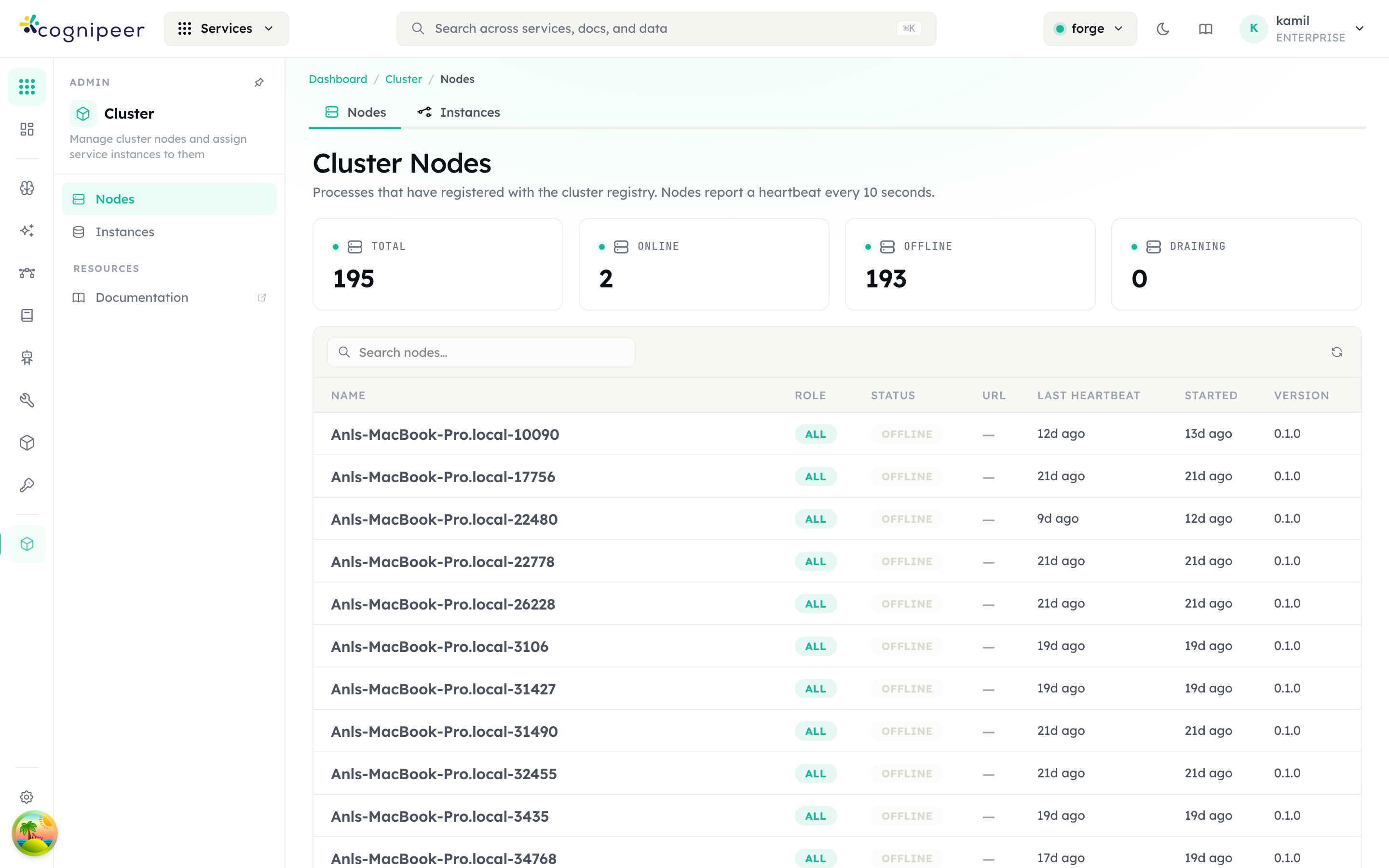
The Nodes tab shows total / online / offline / draining counts and a row per registered process — its role, status, last heartbeat, and version. Processes heartbeat every 10 seconds; the Instances tab is where you pin entities to a specific node.
Topology
A process picks one of three roles via NODE_ROLE:
| Role | Accepts HTTP? | Runs consumers? |
|---|---|---|
main | yes | yes — also services dashboard/API |
worker | no | yes — pure background |
all | yes | yes — default for single-node |
Each process announces itself with a NODE_NAME (defaults to hostname-pid) and a heartbeat. The node record persists in the main database under the nodes table along with role, status, lastHeartbeatAt, startedAt, version, hostname, and pid.
CLUSTER_DEFAULT_NODE_NAME overrides the "default" node that unassigned instances fall back to. If unset, the system picks the most recently active node.
Queue layer
The queue is abstracted behind src/lib/core/queue/queueProvider.interface.ts. Two providers ship today:
| Provider | When it runs | Use it for |
|---|---|---|
memory | In-process Map-backed | Single-node dev/test |
bullmq | Redis-backed BullMQ | Multi-node production |
Selection is automatic: if REDIS_URL (or QUEUE_REDIS_URL) is set, BullMQ activates; otherwise the memory provider takes over. Force it explicitly with QUEUE_PROVIDER=memory|bullmq.
Relevant env:
QUEUE_PROVIDER=auto            # auto | memory | bullmq
QUEUE_REDIS_URL=               # falls back to REDIS_URL
QUEUE_PREFIX=console:q:        # BullMQ key prefix
QUEUE_DEFAULT_ATTEMPTS=3
QUEUE_DEFAULT_BACKOFF_MS=1000
Every service that opts into the queue follows the same shape:
- a consumer file (
*Consumer.ts) registers handlers for the queue named after the service. - an entityId helper (
*EntityId.ts) builds the stable identifier the assignment layer uses.
This pattern is in place for: agentConsumer, mcpConsumer, browserConsumer.
Instance assignments
The assignable entity types today are:
agent · mcp · browser · inference-server · alert-rule · automationEach assignment is (entityType, entityId) → (nodeName, mode) where mode is one of:
strict— the entity only runs on the target node. If that node is offline, jobs queue until it returns.preferred— the entity prefers the target node but will fall back to the default node if the target is unhealthy.
PUT /api/cluster/assignments/:entityType/:entityId sets an assignment; DELETE removes it. Both write an audit log entry (cluster.assignment.set / cluster.assignment.delete).
Dashboard
/dashboard/cluster is split into a topology overview and an instance-assignment editor. The overview lists every node with its status, role, last heartbeat, version, and the assignment count it owns. The editor cross-joins assignments with the full instance list (collected across every tenant) so operators can see at a glance which entities are pinned and which fall back to the default node.
Cross-tenant iteration is unavoidable here — assignments are global to the cluster but instance records live per-tenant. Volume is small (the page tops out at hundreds of rows), so the implementation is a straightforward scan.
API
| Method | Endpoint | Purpose |
|---|---|---|
GET | /api/cluster/overview | Topology snapshot — thisNodeName, defaultNodeName, nodes[], assignments[] |
GET | /api/cluster/instances | All assignable instances annotated with their current binding |
PUT | /api/cluster/assignments/:entityType/:entityId | Pin an entity to a node ({ nodeName, mode }) |
DELETE | /api/cluster/assignments/:entityType/:entityId | Unpin an entity |
All four require a logged-in session; tighten with RBAC once the cluster permission tier lands.
See the Cluster API reference for the full request/response schema.