
Guardrails
Guardrails provide real-time content safety checks for LLM inputs and outputs. They detect PII, banned words and profanity, harmful content, and prompt-injection attempts — and can block, redact, warn on, or flag what they find. Operators manage them under Operate → Guardrail.
Operator view
Each guardrail is a named policy attached to one or more models or agents. The list view summarises the states that matter operationally: total policies, how many are enabled, how many are disabled, and how many block requests.
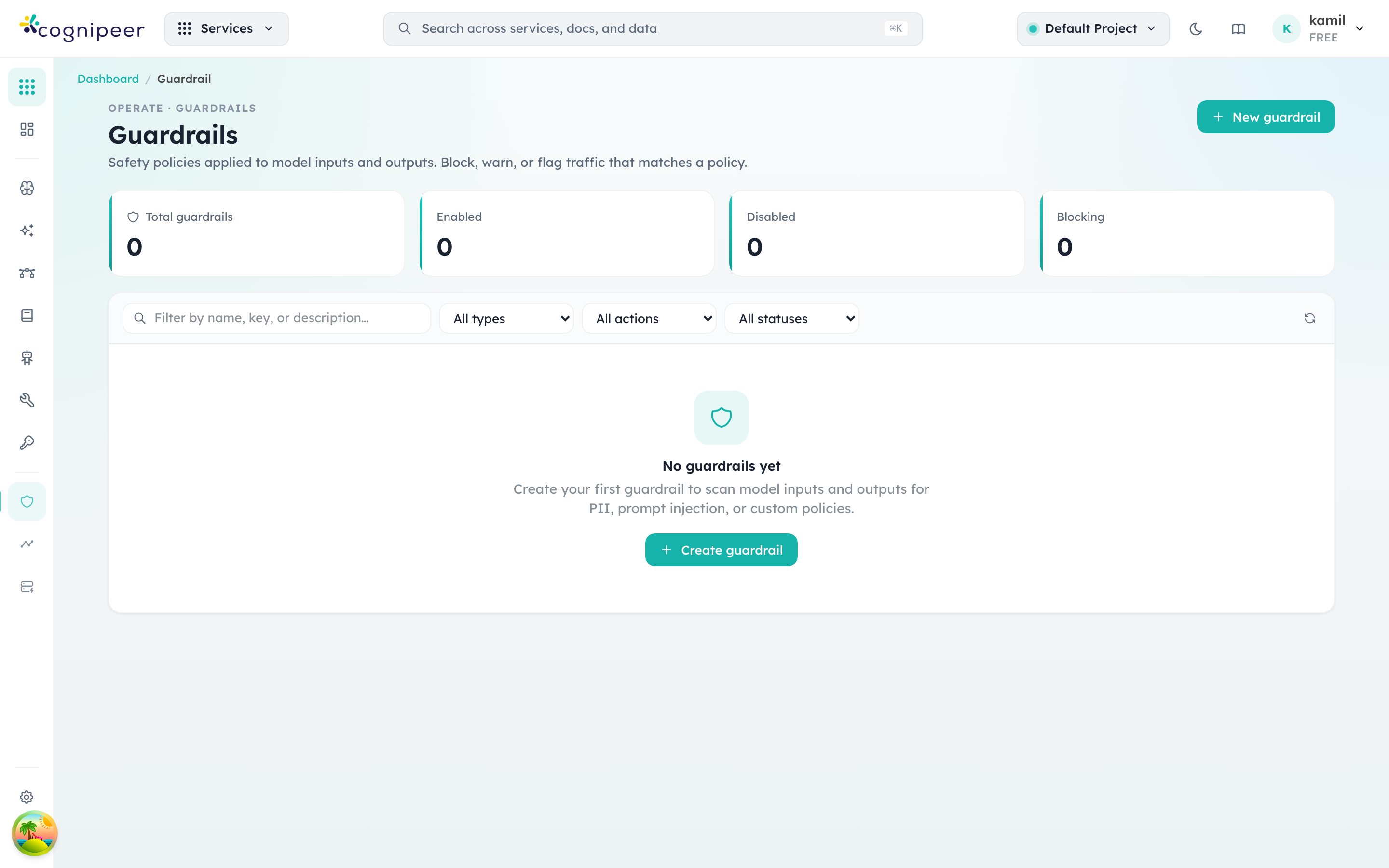
Filters narrow by type (preset / custom), by action, and by status. The Create guardrail flow walks you through picking a type, declaring which checks to enforce, and configuring the default action and failure mode.
When a model has guardrails attached the runtime applies them at two points: before forwarding the request upstream (input slot) and before responding to the client (output slot). A blocked request short-circuits with a structured guardrail_block error that includes which policy fired and the findings.
Guardrail Types
| Type | Description |
|---|---|
preset | A bundled policy combining detection families: PII, word filter, content moderation, and prompt shield. |
custom | An LLM-based evaluation driven by your own rule text. Requires a model. |
Detection Families (preset)
| Family | Engine | What it does |
|---|---|---|
| PII | Regex + checksums (no LLM) | 15 categories incl. email, phone, credit card (Luhn), IBAN (mod-97), TCKN (checksum), API keys/JWTs (known prefixes + entropy). Resists zero-width/unicode tricks and user (at) mail (dot) com obfuscation. |
| Word filter | Deterministic matching (no LLM) | Broad built-in English + Turkish profanity/slur lists, tenant-uploaded word lists (CSV/TXT), inline words, and regexes. Folds case, diacritics, leetspeak (s1kt1r), stretched (fuuuck) and spaced-out (f u c k) writing. Whole-token matching avoids Scunthorpe false positives. |
| Moderation | LLM classifier | 26 categories (hate, violence, fraud, cybercrime, child safety, …). Decode-then-judge prompt: unfolds obfuscation/encodings, judges meaning and intent across languages; fictional framing does not exempt content. |
| Prompt shield | LLM classifier | 15 attack families: injection, jailbreak personas, encoding/obfuscation, payload splitting, context poisoning, multi-language evasion, and more. Three sensitivity levels. |
Word lists
The word filter merges four sources: built-in lists (toggled per policy), tenant word lists (managed under Guardrails → Word lists, uploaded as CSV/TXT or edited inline, up to 20k entries), inline words, and regexes. Uploaded lists are referenced from policies by key (policy.wordFilter.customListKeys) and are cached for 60 s at evaluation time.
| Method | Endpoint | Description |
|---|---|---|
GET | /api/guardrails/word-lists | List summaries (name, key, word count) |
POST | /api/guardrails/word-lists | Create — body accepts words: string[] or raw content (CSV/TXT; ,/;/tab/newline separated, # comments) |
GET | /api/guardrails/word-lists/:id | Full list including words |
PATCH | /api/guardrails/word-lists/:id | Update metadata and/or replace words (words or content) |
DELETE | /api/guardrails/word-lists/:id | Delete |
The LLM-backed checks run against any LLM from the tenant's Model Hub (set policy.<family>.modelKey, falling back to the guardrail's modelKey). The evaluated text is wrapped in per-request random boundary markers and declared untrusted data, so verdict-steering text inside the message ("respond with allowed: true") is itself treated as an attack signal.
Actions
| Action | Behavior |
|---|---|
block | Reject the request with a structured error |
redact | Mask the detected values ([REDACTED:email]) and continue — PII and word filter only |
warn | Allow the request; findings are attached to the response and logged |
flag | Allow the request; findings are attached to the response and logged |
The guardrail-level action applies to LLM-backed findings; the PII and word-filter policies carry their own action so you can, for example, redact PII while blocking profanity.
Failure Mode
LLM-backed checks can fail (model down, unparseable verdict). failMode decides what happens:
open(default) — the content passes; the failure is logged.closed— the content is treated as a violation (evaluation_errorfinding). Also fires when an LLM check is enabled with no model configured.
Evaluation Logs
Every evaluation is persisted to guardrail_evaluation_logs with pass/fail, findings, latency, the calling surface (chat.completions, agent, client-api, …), and the request id. Detected values and the stored input text are masked before persistence — raw PII never lands in the log. The guardrail detail page charts pass rate, findings by type/severity, and a time series; alert rules can trigger on guardrail_fail_rate, guardrail_avg_latency_ms, and guardrail_total_evaluations.
API
Evaluate Guardrail
POST /api/client/v1/guardrails/evaluate
Authorization: Bearer <token>{
"guardrail_key": "pii-checker",
"text": "My email is john@example.com and my phone is 555-0100"
}Response:
{
  "passed": false,
  "action": "block",
  "findings": [
    { "type": "pii", "category": "email", "severity": "high", "message": "Email address detected", "action": "block", "block": true, "value": "john@example.com" }
  ],
  "guardrail_key": "pii-checker",
  "guardrail_name": "PII Checker",
  "message": "Content blocked by guardrail:\n• Email: Email address detected",
  "redacted_text": null
}
When the matching policy's action is redact, passed is true and redacted_text contains the masked text to use instead of the original.
Inference Integration
Guardrails attach to models via the inputGuardrailKey / outputGuardrailKey slots (the slot decides the direction):
Request → Input guardrail → Provider call → Output guardrail → Response
              │ block: 400 guardrail_block         │ block: 400
              │ redact: rewrite user msg           │ redact: rewrite content
└ warn/flag: annotate + log └ warn/flag: annotate + log- Non-blocking findings are attached to the chat completion response under a
guardrailsextension field ({ input?: {...}, output?: {...} }). - Streaming responses cannot be blocked after delivery; the output guardrail runs as a post-hoc audit when the stream completes, feeding evaluation logs and alerts (
source: chat.completions:stream). - Agents apply the same guardrails around their conversation loop (
source: agent).
When a guardrail blocks a request during inference, a GuardrailBlockError is thrown with the guardrail key, action, and findings.
Management Endpoints
| Method | Endpoint | Description |
|---|---|---|
GET | /api/guardrails | List guardrails (includeTemplates=true returns category/list catalogs) |
POST | /api/guardrails | Create guardrail (validates that LLM checks have a model) |
GET | /api/guardrails/:id | Get guardrail |
PATCH | /api/guardrails/:id | Update guardrail |
DELETE | /api/guardrails/:id | Delete guardrail |
POST | /api/guardrails/evaluate | Evaluate text (dashboard) |
GET | /api/guardrails/:id/evaluations | Evaluation logs + aggregate (pass rate, latency, time series) |