
Connect an OpenAI-compatible client
Console speaks the OpenAI wire protocol. Anything that lets you set a base URL and an API key — Open WebUI, LiteLLM, Cursor, the official openai SDKs — can call your models through Console instead of calling a provider directly. The traffic then picks up project scoping, guardrails, usage accounting and spend attribution on the way through.
This page goes from a fresh tenant to a working client: pick the project, read a model key, mint a token, verify with curl, then point the client at it. The gateway is a community feature; no Enterprise licence is involved.
What you end up with
Three values. Every client on this page wants the same three.
| Setting | Value |
|---|---|
| Base URL | https://<your-console-host>/api/client/v1 — no trailing slash, no extra /v1, not /api/v1 |
| API key | a Console API token: cpeer_ followed by 64 hex characters |
| Model name | the model's key from Model Hub — not its display name, not the provider's model id |
The token carries the tenant and the project. Neither is ever read from the request body, so a client that is configured once keeps talking to the same project until you replace the token.
Prerequisites
- A Console account with the role
owner,admin,project_adminoruser— those four roles may mint tokens. - At least one model of category
llmin the target project. If you have none, work through Create your first model first. - The token owner needs Model Hub
readandwrite: listing models is aGET(read), and a chat completion is aPOST(write). RBAC is evaluated against the user who created the token. See Authentication for the role table.
Step 1 — Select the project
The token you are about to create is bound to whichever project is active in the browser at that moment, permanently. Set it first.
The project selector sits in the top bar and shows the active project's name; its menu is headed Switch project.
Step 2 — Read the model key
Open Model Hub (/dashboard/models). The sub-nav has an LLM filter if the list is long.
In the Name column, each row shows the display name in bold with a small monospace string underneath. That string is the model key, and it is the only value model accepts.
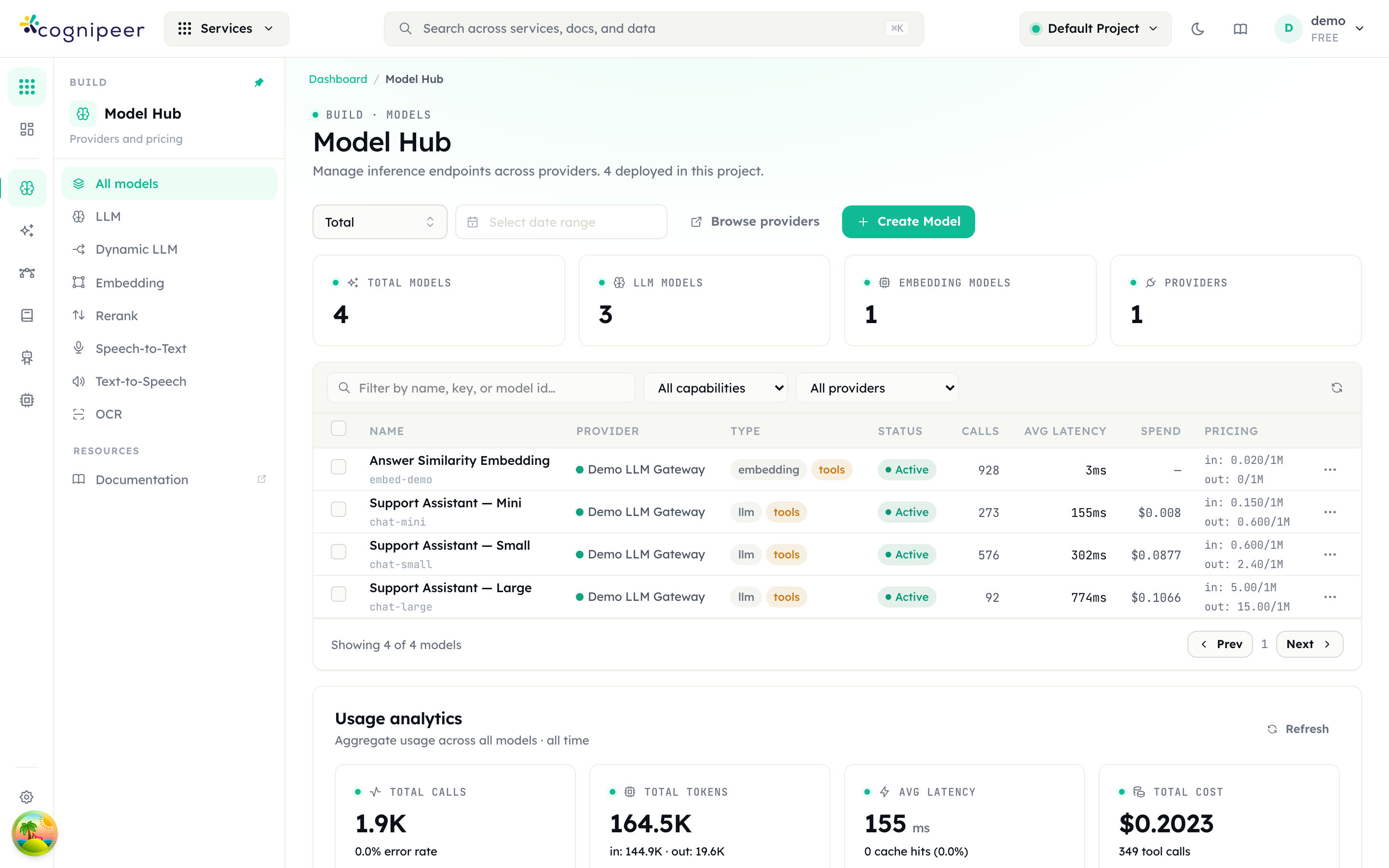
Look at the Name column: "Support Assistant — Mini" is the display name, chat-mini underneath it is the key you send as model. The Type column shows the category — you want llm rows for chat completions.
Step 3 — Create the API token
Open the account menu in the top bar and choose Settings. In the left nav under Settings, choose API Tokens (/dashboard/tokens, page eyebrow "Configure · API Tokens").
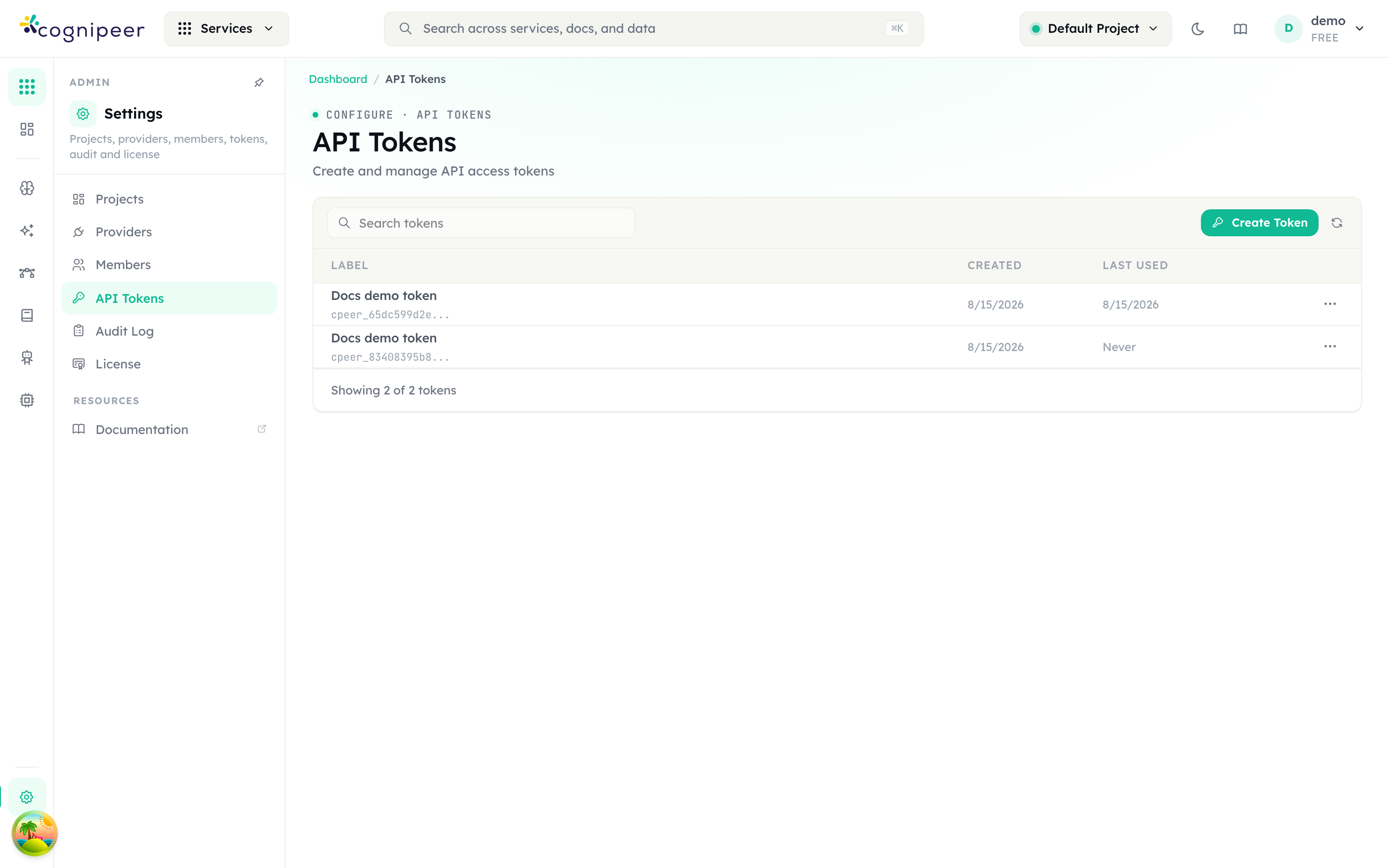
Look at the top right of the grid for the Create Token button, and at the grid rows: each shows the label with a truncated cpeer_… prefix underneath. Only a SHA-256 hash and that 16-character prefix are stored — the full secret is not recoverable from this screen.
- Select Create Token.
- Fill in Token Label — minimum 3 characters. Name it after the client ("Open WebUI", "LiteLLM prod"). The grid shows only Label, Created and Last Used, so the label is the only thing that tells one token from another once the secret is gone.
- Select Create Token in the footer.
- The panel switches to Your New API Token. Under the orange Important! alert, Your API Token: holds the secret. Copy it now — the alert is literal:
This is the only time you'll see this token. Make sure to copy it now! - Select I've Copied My Token.
Deleting a token here is immediate in the database but not instant on the wire — see the gotchas below.
Step 4 — Verify from a shell
Before touching a client, prove the three values work. Replace the host and the token.
export COGNIPEER_BASE_URL="https://console.example.com/api/client/v1"
export COGNIPEER_API_KEY="cpeer_..."

curl -s "$COGNIPEER_BASE_URL/models" \
  -H "Authorization: Bearer $COGNIPEER_API_KEY" | jq '.data'
The response carries both an OpenAI-shaped list and Console's own richer list:
{
  "object": "list",
  "data": [
    { "id": "chat-mini", "object": "model", "created": 1755216000, "owned_by": "my-provider" }
  ],
  "models": [ { "key": "chat-mini", "name": "Support Assistant — Mini", "category": "llm", "…": "…" } ]
}
data[].id is the model key. owned_by is the provider key, or cognipeer when the model has no provider. OpenAI clients read data and ignore models; models carries the full Console model record, with any provider credentials in settings masked.
GET /models returns every category — embeddings, rerankers, STT, TTS and OCR models sit in the same list. Narrow it with a query parameter when you are driving it yourself:
curl -s "$COGNIPEER_BASE_URL/models?category=llm" \
  -H "Authorization: Bearer $COGNIPEER_API_KEY" | jq -r '.data[].id'
Then send a completion:
curl -s "$COGNIPEER_BASE_URL/chat/completions" \
  -H "Authorization: Bearer $COGNIPEER_API_KEY" \
  -H "Content-Type: application/json" \
  -d '{
    "model": "chat-mini",
    "messages": [{ "role": "user", "content": "Say hello in one sentence." }]
  }'
The non-streaming response is a standard chat.completion object plus one non-standard top-level field, request_id. Keep it: it is the correlation key for the request in Console's logs.
Streaming is server-sent events terminated by data: [DONE], with X-Request-Id on the response headers:
curl -N "$COGNIPEER_BASE_URL/chat/completions" \
  -H "Authorization: Bearer $COGNIPEER_API_KEY" \
  -H "Content-Type: application/json" \
  -d '{
    "model": "chat-mini",
    "stream": true,
    "messages": [{ "role": "user", "content": "Count to five." }]
  }'
If all three calls work, every client below is a configuration exercise.
Step 5 — Point a client at it
Python — official openai SDK
from openai import OpenAI

client = OpenAI(
    base_url="https://console.example.com/api/client/v1",
    api_key="cpeer_...",
)

resp = client.chat.completions.create(
    model="chat-mini",                     # the Model Hub key
    messages=[{"role": "user", "content": "Say hello in one sentence."}],
)
print(resp.choices[0].message.content)

# Streaming. Guard on `choices` — the terminal usage frame carries an empty
# `choices` array, exactly as OpenAI's own stream does.
for chunk in client.chat.completions.create(
    model="chat-mini",
    messages=[{"role": "user", "content": "Count to five."}],
    stream=True,
):
    if not chunk.choices:
        continue
    delta = chunk.choices[0].delta.content
    if delta:
        print(delta, end="", flush=True)
JavaScript / TypeScript — official openai SDK
import OpenAI from 'openai';

const client = new OpenAI({
  baseURL: 'https://console.example.com/api/client/v1',
  apiKey: process.env.COGNIPEER_API_KEY,
});

const resp = await client.chat.completions.create({
  model: 'chat-mini',
  messages: [{ role: 'user', content: 'Say hello in one sentence.' }],
});
console.log(resp.choices[0].message.content);
For Console-specific features beyond the OpenAI surface — RAG modules, web search, agents — use the Console SDK rather than the openai package.
LiteLLM
Console is an openai/-prefixed provider to LiteLLM. Map each Console model key to whatever public name you want your callers to use.
# config.yaml
model_list:
  - model_name: gpt-4o-mini                      # the name your callers send
    litellm_params:
      model: openai/chat-mini                    # openai/<Console model key>
      api_base: https://console.example.com/api/client/v1
      api_key: os.environ/COGNIPEER_API_KEY

  - model_name: text-embedding-3-small
    litellm_params:
      model: openai/embed-demo
      api_base: https://console.example.com/api/client/v1
api_key: os.environ/COGNIPEER_API_KEYexport COGNIPEER_API_KEY="cpeer_..."
litellm --config config.yamlDeclare models explicitly rather than relying on model discovery — that keeps non-chat categories out of your chat namespace, which is the failure mode described under Gotchas.
Open WebUI
Open WebUI can be configured at start-up or through its admin screens. Both do the same thing.
At start-up:
docker run -d -p 3000:8080 \
  -e OPENAI_API_BASE_URL="https://console.example.com/api/client/v1" \
  -e OPENAI_API_KEY="cpeer_..." \
  -v open-webui:/app/backend/data \
  --name open-webui --restart always \
  ghcr.io/open-webui/open-webui:main
Through the UI — the labels below belong to Open WebUI's own admin interface, not Console's, and Open WebUI has moved them between releases; if a name does not match your build, look for the equivalent section:
- Admin Panel → Settings → Connections, in the OpenAI API section, add a connection.
- API Base URL =
https://console.example.com/api/client/v1. No trailing slash and no extra/v1. - API Key = the
cpeer_token. - Use the connection's verify control to confirm Open WebUI can reach
/models, then save and reload the page. - Admin Panel → Settings → Models — hide every entry that is not an LLM. Console returns the whole model catalogue and Open WebUI lists all of it; an embedding or TTS model left visible will fail the moment a user picks it.
- Optional: point Admin Panel → Settings → Documents (embeddings) and Admin Panel → Settings → Audio (speech-to-text and text-to-speech) at the same base URL and key, choosing the Console keys of your
embedding,sttandttsmodels. Those hit/embeddingsand/audio/transcriptions,/audio/translations,/audio/speechrespectively.
Gotchas
Read these before filing a bug
/modelsreturns every category. Embedding, rerank, STT, TTS and OCR models appear alongside LLMs. Selecting one for chat returns HTTP 500 withModel is not configured for chat completions. Hide non-LLM entries in the client, or filter with?category=llmwhen you drive the endpoint yourself.- An unknown model key is a 500, not a 404. The body is
{"error":{"message":"Model with key <key> not found","type":"server_error"}}. A typo in the model name looks like a server fault. Check the key againstGET /modelsfirst. - The
Bearerprefix is case-sensitive. The edge check matchesBearerexactly;bearer cpeer_…returns 401 before the token is ever looked up. The message isMissing or invalid Authorization header. Use: Bearer <token>. - Parameters outside the forwarded set are dropped. The gateway forwards a fixed set of request parameters; anything outside it is discarded unless the model has Forward unrecognised caller parameters enabled (
settings.allowUnknownPassthrough, off by default). Dropped by default:n,logit_bias,user,logprobs. usageonly rides on a stream when you ask for it. Sendstream_options: {"include_usage": true}and the counts arrive on a final{"choices": [], "usage": {…}}frame, as OpenAI specifies. Without it, no frame carriesusage— billing and quota are still accounted for server-side. A model that listsstream_optionsunder Also reject these, or has it auto-detected as unsupported, suppresses the frame, and client-side token counters then read zero.- Streaming stays on when your request carries
tools. If an upstream genuinely cannot stream tool calls, setdisableStreamingWithTools: truein that model's Settings JSON; the gateway then answers a streamed tool-carrying request in a single frame for that model only. - Token authentication is cached for 60 seconds. A deleted or newly permission-changed token can keep working for up to a minute. Expiry is re-checked on every request and is not subject to the cache.
- There is no legacy
/completionsendpoint. Only/chat/completions. Clients that fall back to the text-completion API will 404. /api/models/v1is a dead prefix. It appears in some older material. It is allowlisted but nothing serves it. The base URL is/api/client/v1.- A token is bound to one project. It was fixed at creation time from the active project and cannot be repointed. A client that needs a second project needs a second token.
- Upstream 4xx responses keep their real status. A provider rejecting a parameter reaches your client as a 400, not a masked 500, so a permanent failure stops looking like a transient one. Retry on 429 and on 5xx; do not retry the other 4xx codes. Console does not currently set a
Retry-Afterheader on 429s, so use your client's own backoff rather than waiting for one. - A blocked guardrail returns HTTP 400 with a non-standard body:
{"error":{"type":"guardrail_block","message":…,"action":…,"findings":[…],"guardrail_key":…}}. Generic OpenAI clients will surface it as an opaque bad request. See Guardrails.
Where to go next
- Chat Completions API and Embeddings API for the full request and response reference.
- Model Inference for how a request is resolved, retried and priced.
- Model Hub for the model list, detail tabs and runtime settings.
- Authentication for the token format and user roles.
- API Reference Overview for everything outside the OpenAI-compatible surface.